
- Founder Story
Why I Left Consulting to Bridge the North America–India Soft-Skills Gap
Distributed software teams in the North America–India corridor are losing money, time, and the opportunity to pursue more ambitious work. They're losing it to a persistent soft-skills gap. I left traditional consulting to close it.

I went quiet on professional social media for two years.
During that time, I was heads-down on the work. Developing training programs and building with AI. One of the training programs I built was piloted with Accenture.
Here's how the two tracks broke down:
- Soft-Skills Training. Consulting engagements with North American firms, focused on direct training in small groups. Much of this opened up after I dedicated time to research: interviewing managers and knowledge workers on both sides of the North America–India offshoring corridor in order to build formal training programs that addressed their biggest pain points.
- Artificial Intelligence. Agentic workflows for knowledge work and operations: MCP integrations, multi-agent orchestration, retrieval pipelines, and internal apps built with the engineering rigour I'd bring to any production codebase. Knowing how to properly architect systems turns out to be useful when you're directing coding agents on software you'll actually have to maintain.
Staying hands-on is also how the soft-skills work stays tethered to the tools reshaping the day-to-day of the North American and Indian software teams I serve.
I believe that, eventually, AI will handle systems architecture better than we experienced software engineers do today. Until then, soft skills remain a huge differentiating factor in amplifying our technical expertise. They matter most when the work is shipping software across teams, time zones, and trust gaps.
In fact, soft skills matter more than ever given the speed of production at which AI tooling now enables.
My own journey starts with 30 years in tech. The last few years of client work, though, have been spent bridging North American consulting firms with their offshore software teams in India. From this vantage point (working on the North American side of the corridor as engineer, architect, project manager, and product owner), the opportunities to work smarter have been easy to spot. They are hiding in plain sight.
If you've worked this corridor yourself, I suspect they aren't hiding from you either. You may not have named them yet. But you've felt them.
What I kept seeing
Working with firms that had sizable offshore teams, I kept noticing the same pattern. The deliveries landed. Smart individual contributors overseas, interesting projects, work that succeeded on paper. But too often, the work cost more than it should have. These extra costs showed up in time and goodwill. Of course, time is also money. It's the hidden tax most North American firms have just assumed to be the cost of doing business with an offshore team.
Both sides of the corridor had long ago absorbed that overhead as the price of working across cultures and time zones.
I kept thinking about why the communication and soft-skills gap persisted. Professionals in India were hungry to deliver good work and to fit in with their North American peers. Their working English was strong. These professionals were, however, running on a different cultural operating system from their peers and leadership in North America.
I knew the status quo was costing organizations with this distributed setup both time and money. It's also mentally draining for people working on either side of the corridor when we don't feel understood.
It wears on me when it takes 30+ minutes of conversation with an offshore colleague to convey all the nuance I could have conveyed to a North American colleague in just 10 minutes. I call the 10-minute version "high-bandwidth" communication.
In seeking to get closer to that smoother interaction that I missed, I found myself not only guiding my team on the work to be done, but increasingly, providing them with rules of thumb for more streamlined communication: written and behavioural.
I took on this side quest selfishly. I'm North American, raised here, working here, and the overhead of collaborating with colleagues in India quietly drained me in a way that working with my North American teammates did not.
The high-bandwidth communication I've experienced led to flow states. It's gratifying—a natural high. With my North American colleauges, I would regularly enter these flow states, and that energized me. Interactions missing this collaborative rhythm, however, just left me depleted. With local colleagues, we could jam at a whiteboard, riffing at the speed of thought instead of constantly pausing to unwind a tangent of broken understanding.
Part of achieving this high is knowing that you can talk at increasing levels of abstraction: rising to the level of overarching goals and concepts. Not simply collapsing the interaction down to a laundry list of discrete tasks to be offloaded.
I've captured a related frustration on my website landing page in the Overcoming Challenges section. It's the vignette entitled "They only do exactly what I ask". Here's that same vignette:
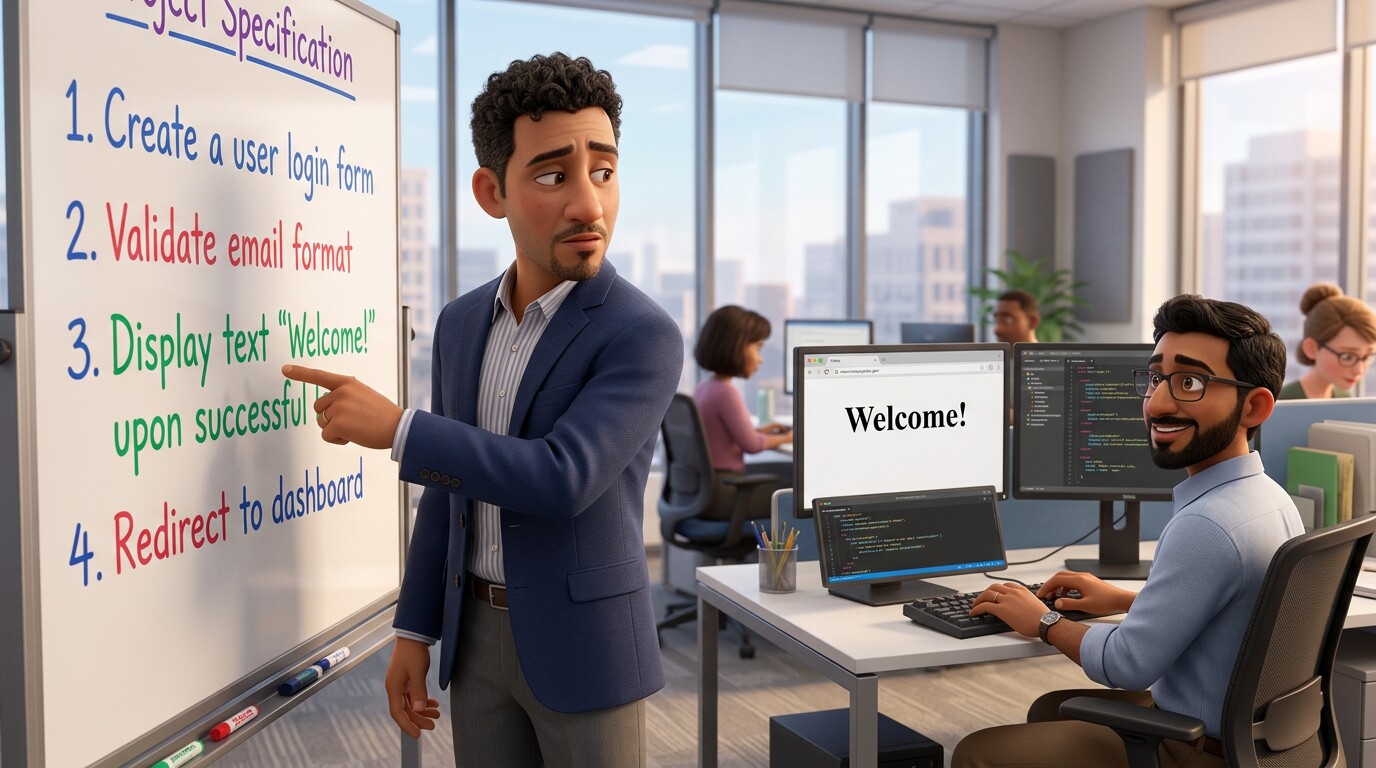
When requirements are ambiguous or priorities shift, you need team members who adapt and problem-solve, not wait for step-by-step instructions.
Each group of colleagues (local vs offshore) carries a different mental model of workplace conventions and communication. These differences often shows up as friction in meetings, work artifacts, communication norms, and even problem ownership.
Often, it's the kind of friction that's small in any single moment but exhausting in aggregate.
That frustration is what drove me to engage. Where there's a genuine problem, there's usually an opportunity. It was a simple extrapolation: other North American business owners and employees were almost certainly paying the same quiet tax.
My Indian colleagues, though, were carrying the heavier end of it: working just as hard, doing technical work that was at times solid. Their work was also, at times, pulled down by the very same soft skill gaps that went unaddressed. They received appreciation from leadership when they got it right, but they were almost never coached through the layered skill building that would have meaningfully narrowed the gap.
Having a manager repeatedly exclaim, "Be direct", "Be proactive", or "Ask if you're unclear" almost never lands. Sure, it's well intentioned. It's just not enough.
Behaviours sit on layers of understanding that need systematic rebuilding, not exhortation alone. Only then can a team disengage their culturally reflexive autopilot.
It's unfair of us in North America to expect change in this regard through an imperative utterance alone, regardless of whether it's stated once or repeated a dozen times.
Contemplating the next mountain
In early 2023, just before this gap took centre stage in my thinking, my friend Ajay Batish recommended the book From Strength to Strength by Arthur C. Brooks. The book's message for experienced professionals resonated: transition from work that demands fluid intelligence to work that leans on crystallized intelligence, the latter being the accumulated wisdom from years of applying the former.
At this same time, AI was clearly on an accelerating, exponential trajectory. Everyone paying attention knew the nature of knowledge work was about to change underneath us. Between Brooks and the AI curve, I started contemplating what my next chapter might be. In Brooks' parlance, this was my next mountain.
When the asks reached me
At the time, I was serving as a technical lead on a distributed team, with product owner and project management responsibilities. Staff in India I worked with would often ask for guidance on how to communicate their ideas effectively.
The common thread?
These software professionals wanted to communicate the way I did. Same rigour, same packaging. They wanted their technical writing to be precise, their ideas well-organized. They wanted to surface risk early in a project rather than at the demo, and to disagree with North American stakeholders without burning trust. They wanted to articulate their points of view with confidence, hold their own in live meetings, present well, and even handle small talk effectively. With colleagues, of course. In front of clients, especially.
All of those wants pointed to a single idea: their work and their judgment should carry more weight with the organization's stakeholders, and through that, the organization's mission.
One request in particular, struck me. A senior engineer asked me, point-blank, if I would personally coach him on his professional communication after he began to stumble as a new hire with us.
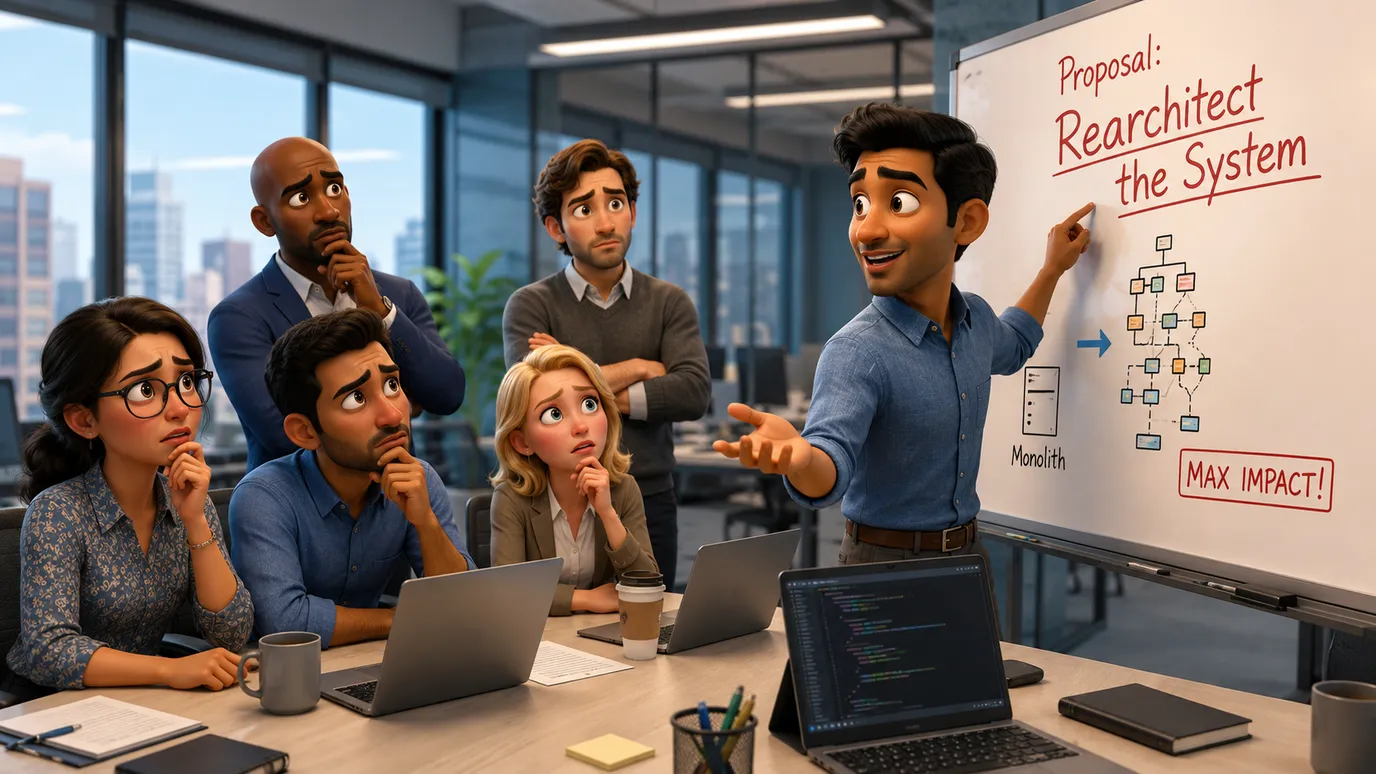
Working with a North American team for the first time had made his cross-cultural blind spots impossible to ignore. He wasn't picking up on our signals. Only later did he learn that his confident pitch to "rearchitect the system", just one week into the job, hadn't read to leadership as ambition. It had set off alarm bells. He hadn't actually meant a full rearchitecture; it's just that he reached for an English word that telegraphed a more substantive overhaul than he had actually intended to suggest.
Perhaps our new hire thought that using an impressive-sounding word like rearchitect would signal confidence and authority to others. But by the time anyone explained to him that his proposal came across as reckless, he had already lost the trust of much of our senior leadership. We, understandably, didn't want cowboys running loose through our production systems.
Where had L&D fallen short, that members of the offshore team would seek these insights from me?
Granted, I had the software management context. As a lifelong software engineer myself, I understood their world. And being of Indian heritage, I understood the cultural forces shaping their motivations and behaviours.
Even so, coaching L&D style wasn't what I'd been hired to deliver, as much as I have always had an affinity for teaching. True, I had weekly 1:1 in-team coaching sessions with my direct reports on the North American side, but the organization I was working with had set things up so that staff in India would have their own, India-based in-team coach.
The fact that these requests were reaching me at all meant there was an L&D gap.
I now understood why, of course. The requests coming my way were hyper-specific. L&D offerings aren't known to be this specialized. And pre-AI, how would training even scale (cost-effectively) to provide personalized feedback?
There was a real need sitting unaddressed on both sides of the time-zone divide.
To be sure, effective bridging across this corridor is bidirectional. North American leaders also benefit from cultural fluency. But the highest-leverage investment in my analysis, at least for now, sits with the professional ICs on the India side. Their growth is the most direct lever a North American business has on its return on offshore work. It's also where the ICs themselves have the most personal upside in engaging fluently with the culture and conventions of the businesses they serve.
Why the gap hasn't closed yet
The soft-skills training gap in this North America–India corridor hasn't closed yet for several reasons. I categorize them into the following three buckets:
- Training Material. L&D curricula don't address the reality of distributed software teams in the North America–India corridor with the requisite specificity.
- Specialization. Leaders on the North American side often lack the context, time, or frameworks to conduct this training alongside their delivery responsibilities. Culturally loaded feedback is also risky to give without a grounded, purpose-built framework.
- Time Window. The overlap window between time zones is already short. Subtract the meetings already filling that window, and the time available for context-specific mentorship is down to minutes, not hours.
Breaking it down this way, I had seen enough to know there was a need in the market to be addressed. And so I left traditional project management consulting to pursue a novel, scalable, and personalized way to close the soft-skills gap in the North America–India corridor.
What I'm building now
To be clear, I haven't stopped consulting altogether. AI engineering work and the consulting that goes hand in hand with training engagements are still part of the mix. What changed is what sits at the centre of my work. It's now soft-skills training.
In practice, this means teaching the day-to-day behaviours that change how distributed teams trust each other: clarifying early, surfacing risk, calibrating updates to the audience, disagreeing professionally, and taking ownership. This is done with real software-work contexts through case studies and role play; not as abstract communications theory.
Alongside that, I've been using AI to automate the personalized feedback students receive in the training programs I'm developing.
AI has been indispensable for running what is, for now, a one-person operation. Staying hands-on with state-of-the-art AI is also how I stay sharp for the engineering clients who still bring that work my way.
To sharpen my own thinking on why this gap persists, I've looked to Cultural Intelligence (CQ) research. The vocabulary of CQ research has given me a language for the patterns I was seeing and the interventions I was already building into my learning objectives, lesson plans, and learning activities. David Livermore's body of work, in particular, has shaped a lot of how I think about these topics.
While this post is a general introduction to my founder journey, I've written in more depth about the evidence behind the soft-skills gap, and how it affects both audiences (businesses, individuals).
The following articles, which draw on research in the field, can be found on my website:
- The Evidence Behind What We Do — for business leaders
- The Gap Nobody Told You About — for individual professionals
With the launch of this blog, I'm now ready to share what I've learned on the soft-skills training side for teams and individuals bridging the North America–India corridor.
If that's you, what's your biggest unsolved friction point? Tell me in the comments or tag me on LinkedIn or X.
I'd love to hear from you.
Join the discussion